


The Situation: NVIDIA GB300 UAE Approval
In September 2025 the US government authorised Microsoft to export Nvidia’s GB300-class chips to the United Arab Emirates (UAE).
Confirmed in early November, the decision extends advanced compute access to a close regional partner under strict oversight conditions, signalling Washington’s shift from restriction to managed diffusion.
The decision fits an emerging US foreign policy strategy: pairing selective release of advanced AI chips with binding compliance controls to contain Chinese influence.
The Red Line: Dependency, Diffusion, Containment
This authorisation forms part of a series of bilateral agreements dating back two years.
The structure combines outbound compute, inbound investment and mandatory alignment with US rules. The result is a corridor through which US-compliant capacity can scale across the Middle East.
In effect, Emirati capital underwrites US infrastructure, while US export licences govern Emirati capacity.
The four-part architecture combines funding, compliance and computation.
capital commitments from Abu Dhabi into US technology and infrastructure (US$1.4trn);
compute access into the UAE under export-control conditions (up to 500,000 advanced Nvidia chips each year);
standards and security compliance, limiting space for Chinese alternatives; and
replication in other regions, for which India and Argentina could be candidates.
The central mechanism linking these parts is Stargate, a US-based AI infrastructure programme for OpenAI, in which the UAE is the first external participant.
A deepening bilateral dependency
Investment framework (March 2025): a ten-year, US$1.4trn programme covering AI infrastructure, semiconductors, quantum, biotechnology and energy, establishing a direct investment pipeline from the UAE into the US;
US-UAE AI Acceleration Framework (May 2025): commits the UAE to finance or build US data-centres of equal or greater capacity than those developed domestically and align national-security regulation with US standards;
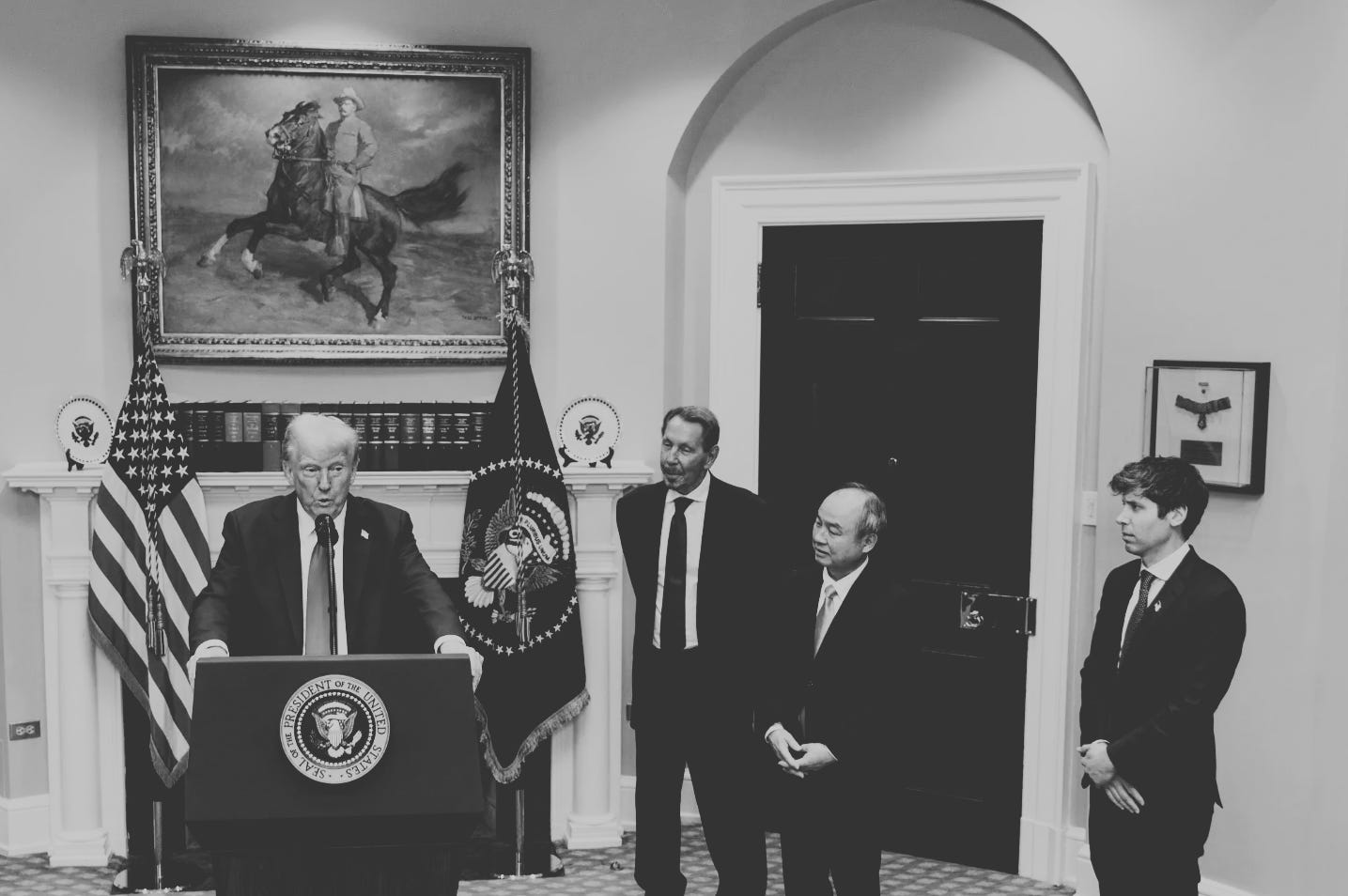
Project Stargate UAE (May 2025): the partnership between the Emirati investment firm G42 and Oracle, Nvidia, Cisco and SoftBank, hosting 1 GW cluster in Abu Dhabi while investing in the larger Stargate US network. Stargate US is a US$500bn investment programme to build new AI infrastructure for OpenAI in the US, with MGX—the UAE investment firm backed by G42 and the sovereign wealth fund Mubadala—as a key investor.
AI Infrastructure Partnership acquisition (October 2025): a US$40bn transaction bringing nearly 80 Aligned data-centre facilities under MGX-backed control, consolidating Emirati capital inside US digital infrastructure. This marks tangible progress within the US$1.4trn framework.
Together, they establish compute diplomacy as a new instrument of US foreign policy.
While structured as mutually beneficial, the arrangement tilts advantage towards Washington, pocketing the real price: regional leverage.
Diffusion as diplomacy
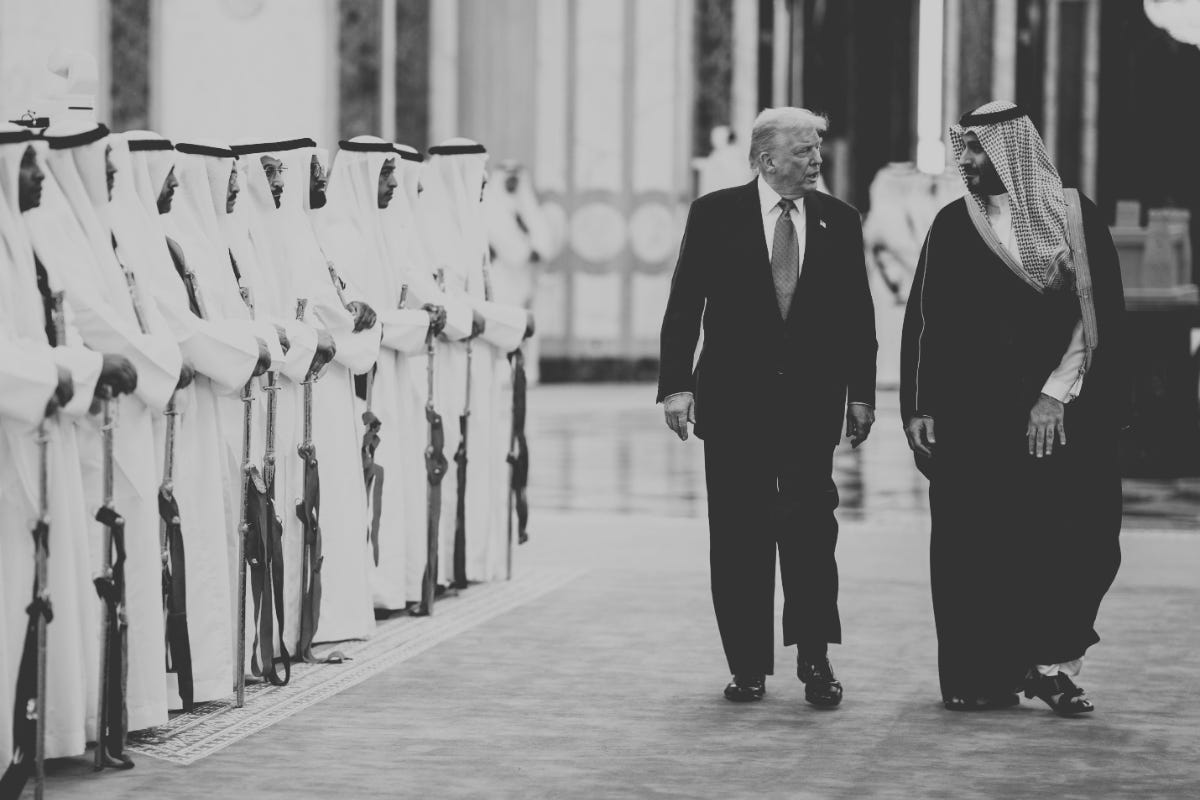
OpenAI estimates that the planned 5 GW UAE facility could support services across a 2,000–mile radius—covering markets from East Africa to southern Europe and western India—an area home to nearly half the world’s population.
The diffusion of US hardware, software and standards serves Washington’s aim of shaping the infrastructure of emerging AI economies.
Microsoft argues that diffusion now matters as much as frontier model development. A February 2025 initiative by Microsoft, G42 and the Mohamed bin Zayed University of Artificial Intelligence launched the Responsible AI Future Foundation to extend this reach. The initiative frames a new bargain for emerging economies: access to compute tied to Western oversight.
The approach positions the UAE as a regulated distribution node for compliant AI capability, embedding US-aligned governance frameworks before rival systems mature.

Containment by compliance
A dense US operational control network sits at the heart of the deal.
A 2024 inter-governmental Microsoft–G42 assurance agreement introduces export-control monitoring, data-protection rules and security obligations.
Microsoft’s US$1.5bn equity stake in G42 gives it visibility into governance.
Cisco oversees the G42 regulated technology environment as integration partner to verify compliance and to prevent unauthorised system transfer.
Stargate UAE also serves as the pilot site for OpenAI for Countries. OpenAI for Countries is designed to spread “democratic AI”, defined as the development, use and deployment of AI that protects and incorporates long-standing democratic principles, such as market openness and limits on state surveillance. In exchange for a joint national start-up fund, in-country data capacity, and a custom GPT, OpenAI for Countries gains operational visibility into data-centre and physical security, paired with direct foreign investment in Stargate US.
As long as Stargate and OpenAI for Countries are jointly offered, variants on the UAE model can be expected.
This structure ties access to verifiable alignment. The model raises switching costs on two fronts: exposure to US-infrastructure upside and dependence on US vendors.
Huawei’s competing chips have yet to match performance or reliability, leaving the US the sole frontier-compute supplier in the Gulf—for now.
Risks for the US
The playbook faces operational, political and competitive risks that could test its durability.
Export-control continuity
Changes in leadership could alter the enforcement or prioritisation of technology controls. Policy shifts between the Trump and Biden administrations illustrate how priorities can diverge, particularly on outbound investment screening and semiconductor export rules.
Third-country technology exposure
Continued Gulf engagement with Chinese technology firms could draw renewed scrutiny from Washington. Previous US pressure over Huawei’s activities in the UAE and subsequent restructuring within G42 shows that this channel of influence remains active.
Execution risk
The planned 5 GW UAE build-out depends on chip supply, export-licence approvals, power availability and phased commissioning. Any disruption in these inputs, or acceleration in China’s chip export capabilities, could narrow the current US advantage. China’s challenge hinges on whether it can build and export viable compute before US systems entrench regionally.
Model replication
The UAE arrangement offers a potential template for combining capital flows, compliance conditions and high-end compute access. Early participation by Norway and the United Kingdom shows partial uptake, though the scale and purpose differ in each case. Discussions with India and Argentina suggest that the model could travel, but it remains unclear whether the US intends to maintain single regional nodes or expand more broadly.
Sovereign ambition
China’s ability to compete depends on closing gaps in volume, energy efficiency and performance per watt. The mid-2025 US agreement with Saudi Arabia integrates Riyadh into Washington’s technology orbit and limits incentives for a separate, non-aligned AI stack. Official reports indicate broad Saudi investment commitments of roughly US$600bn in the US and an initial allocation of around 18,000 Nvidia Blackwell GPUs. Unlike the UAE, however, Saudi Arabia remains outside Stargate, and its compute expansion remains more modest.
Political continuity will shape outcomes, yet the depth of capital and compliance ties suggests that the corridor could outlast electoral cycles.

The Signal: Template Replication
In July and September 2025, Norway and the UK joined OpenAI for Countries with their own Stargate hubs, planning deployment of roughly 100,000 and 8,000 GPUs respectively. The UK arrangement emphasises domestic compute for national use, while Norway’s model provides spill-over capacity for Northern Europe.
Public statements reference exploratory discussions for a 500 MW Stargate project in Argentina (signed letter of intent) and a potential 1 GW facility in India. To date, only one Middle East location has been associated with Stargate. If this persists, it may indicate a preference for concentrated oversight and single-node diffusion per region rather than parallel hubs.
THE RED LINE VIEW
The US-UAE deals alters the regional balance in the Middle East by concentrating high-end compute, tying access to compliance and shaping early perceptions of advantage. The question now is whether this US architecture expands faster than China can respond.